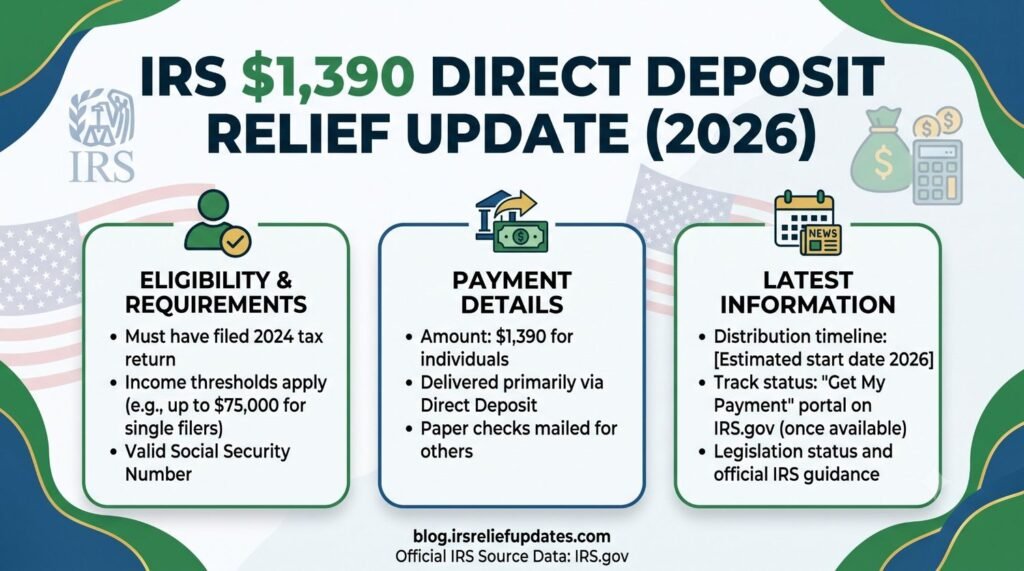
Reports about a potential $1,390 IRS direct deposit relief payment continue circulating into 2026 as households across the United States deal with ongoing pressure from rising living costs. While the idea has gained widespread attention online, no official confirmation has been issued by the IRS or U.S. Treasury as of June 2026.
This article explains what is being reported, how such a payment would typically work, and what Americans should know to stay prepared and protected from misinformation.
Why the $1,390 Relief Payment Is Being Discussed
The concept of a $1,390 relief payment is being linked to broader discussions about inflation support and targeted federal assistance programs.
If a program like this were implemented, it would aim to help households manage:
- Rent and housing costs
- Grocery and food expenses
- Utility bills
- Healthcare and prescription costs
- Transportation expenses
However, at this time, this remains speculative and not an active federal program.
Current Status (June 29, 2026)
As of now:
- No $1,390 relief program has been approved
- The IRS has not announced any payment schedule
- No official eligibility rules exist
- Reports online are based on speculation or unverified claims
Any real federal relief program would require formal approval from Congress and official IRS implementation.
How a Payment Like This Would Likely Be Delivered
If a federal relief payment were approved, the IRS would typically use existing systems:
- Direct Deposit – fastest method for most taxpayers
- Paper Checks – mailed to registered IRS addresses
- Prepaid Debit Cards – issued when banking details are unavailable
Most recipients in past programs have received funds through direct deposit.
Possible Eligibility (If a Program Were Approved)
While no official rules exist, past federal relief programs suggest possible eligibility could include:
Income-Based Guidelines (Estimated)
- Single filers: up to ~$75,000
- Married filing jointly: up to ~$150,000
- Head of household: up to ~$112,500
Higher-income individuals may receive reduced payments or be excluded depending on final rules.
Likely Eligible Groups
If implemented, eligibility could include:
- Low- and moderate-income taxpayers
- Social Security recipients
- SSI and SSDI beneficiaries
- Veterans receiving VA benefits
- Tax filers with valid IRS records
Payment Timeline (Hypothetical Scenario)
Since no program is confirmed, any timeline is purely speculative. If approved, distribution could follow a phased rollout:
- Phase 1: Direct deposit recipients
- Phase 2: Paper check distribution
- Phase 3: Debit card issuance
- Phase 4: Late filings and corrections
Actual timing would depend entirely on federal approval and IRS processing capacity.
Economic Impact (If Implemented)
Supporters argue that a payment like this could:
- Provide short-term relief for struggling households
- Increase consumer spending during high-cost periods
- Support local businesses and essential services
Economists also caution that large-scale payments must be carefully structured to avoid inflationary pressure or budget strain.
Important Warning: Avoid Scams
The IRS does not:
- Call or text asking for banking details
- Request Social Security numbers via email or social media
- Charge fees to release payments
Always rely only on official sources such as IRS.gov for accurate updates.
What You Should Do Now
Even without a confirmed payment, Americans can stay prepared by:
- Filing taxes accurately and on time
- Keeping banking details updated with the IRS
- Monitoring official IRS announcements
- Avoiding unofficial websites and viral social media claims
Frequently Asked Questions
Is the $1,390 IRS payment confirmed in 2026?
No. As of June 29, 2026, there is no approved federal $1,390 relief payment.
Who would qualify if it is approved?
Likely low- to moderate-income taxpayers and certain federal benefit recipients, depending on final rules.
Would payments be automatic?
In past programs, eligible recipients received payments automatically through IRS records.
Would this affect Social Security or other benefits?
Historically, similar relief payments did not reduce federal benefits.
Is the payment taxable?
Confirmed past stimulus payments were not taxable, but no current program exists.
Conclusion
The $1,390 direct deposit relief payment remains unconfirmed in 2026, despite ongoing online discussions. Americans should rely only on verified IRS and government announcements to avoid misinformation.
Staying financially prepared, keeping tax records updated, and ignoring scams are the best ways to remain ready if any future federal relief program is officially introduced.